Understanding Cap Crown Profiles
Crown profile describes the height and front slope of a cap. It shapes fit, style and logo space, and it should be specified in millimeters rather than by name alone.
Updated · Caps Island product development
Key takeaways
- Low, mid and high profile are relative terms. Specify front panel height and crown depth in millimeters.
- High profiles almost always need a structured front; low profiles work structured or unstructured.
- Brim shape changes how a profile reads: flat brims suit tall crowns, pre-curved brims suit low and mid crowns.
- Front panel height limits logo size and affects which decoration methods work well.
- Settle the profile before sampling, because it drives the panel pattern and buckram choice.
What crown profile describes
Crown profile is the shape of the cap body above the brim, viewed from the side. It is defined mainly by two things: the height of the front panels from the brim seam to the button, and how steeply the front rises before it rounds over toward the back. Factories and brands use the shorthand low, mid and high profile, but these are relative descriptions rather than fixed measurements. One maker's mid profile can sit close to another maker's high profile, which is why a profile name alone is never enough to specify a cap.
Profile matters because it controls how the cap sits on the head, how much front area is available for a logo, and how the style reads at a glance. A low, rounded crown looks casual and sits close to the skull. A tall, upright front looks bolder and leaves room for large embroidery. Most buyers choose a profile based on their audience first and on decoration second, then confirm the exact numbers during development.
- Low
- Mid
- High
Low, mid and high profile compared
The table below summarizes the practical differences. Treat the descriptions as starting points; the final dimensions are set in the tech pack.
| Profile | Typical shape | Usual structure | Common styles | Logo area |
|---|---|---|---|---|
| Low | Shallow crown, front slopes back early, rounded top | Mostly unstructured or lightly structured | Dad caps, washed caps, some truckers | Compact; suits small to medium logos |
| Mid | Moderate front height with a gentle slope | Structured or unstructured | Classic baseball caps, curved-brim snapbacks, performance caps | Balanced; works for most embroidery and patches |
| High | Tall, upright front panels, flatter top line | Almost always structured, often with firm buckram | Flat-brim snapbacks, foam-front truckers, streetwear styles | Largest; suits bold 3D puff and wide patches |
Low-profile caps are often called dad caps when they are made from soft cotton twill with an unstructured front and a strapback. They fit closer to the head and suit wearers who find taller caps too prominent. Mid profile is the safe middle ground and the most versatile choice for corporate and promotional programs, where one cap has to suit a wide range of heads and faces. High profile is a deliberate style statement. It pairs naturally with a flat brim and a snap closure, and it gives the most vertical space for decoration.
How structure and profile work together
Profile and structure are separate decisions, but they influence each other. Structure comes from buckram or fused interlining behind the front panels. It holds the front upright and keeps the shape crisp on the shelf and on the head. Without it, the front panels relax and the crown settles lower than its pattern height. The trade-off is covered in detail in structured vs unstructured caps.
A high profile almost always needs structure, because tall unsupported panels fold or dent at the center seam. A low profile can go either way: unstructured gives the relaxed, washed look, while a lightly structured low crown keeps a neat front for a corporate logo. Mid profile is where the choice is most open, and where buyers should look closely at a sample before deciding.
- Firm buckram keeps a tall front flat and stable, which helps large embroidery and patches sit without puckering.
- Soft fused backing gives a structured look with a gentler hand feel, common on mid-profile performance caps.
- No buckram lets the front follow the head. The cap looks lower once worn than it does flat on a table.
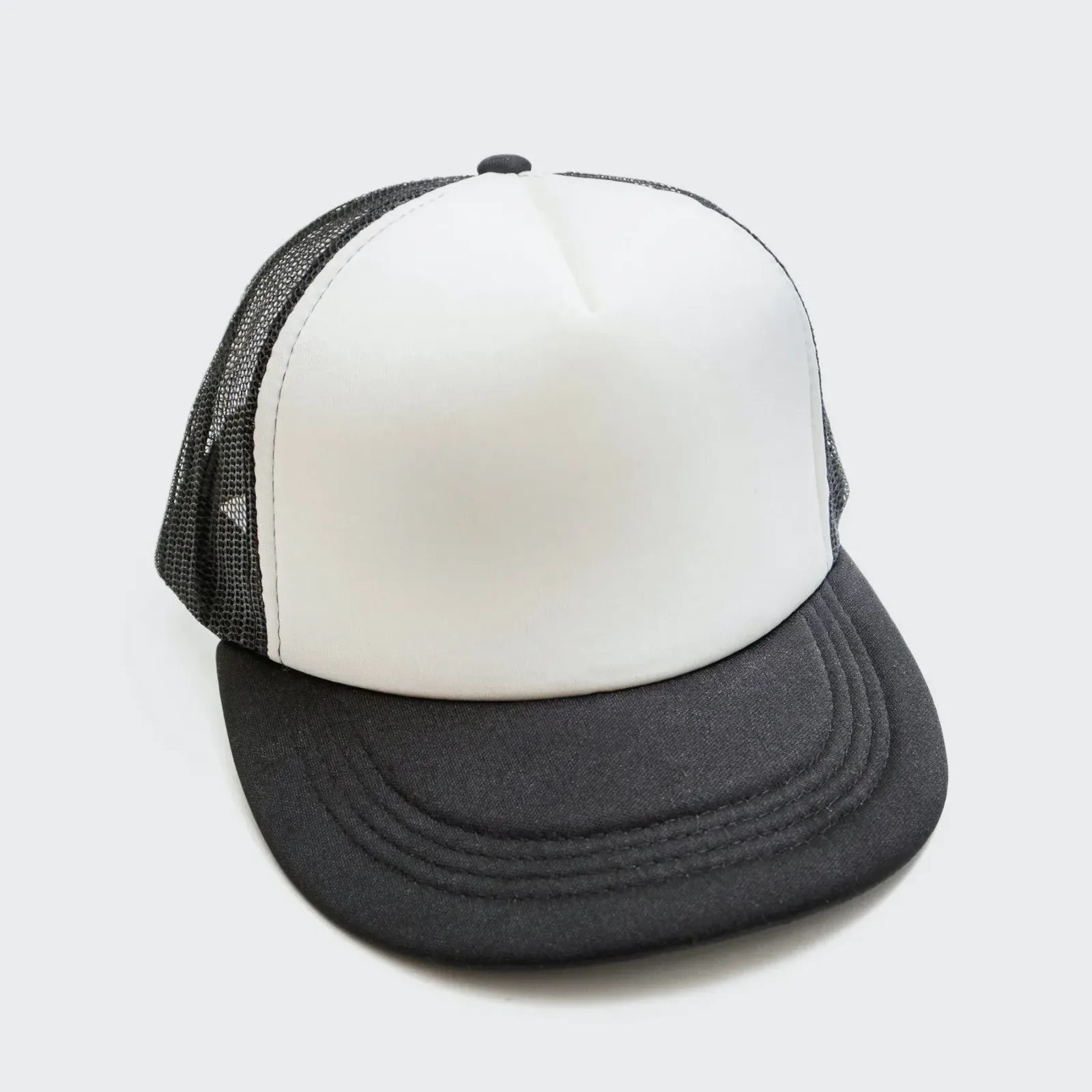
- Foam fronts on truckers act as their own structure, which is why foam-front styles tend to have a high, upright face.
The panel layout also plays a role. A six-panel cap has a center seam on the front, which gives the front a defined crease line. A five-panel cap has one wide front panel with no seam, which presents a smoother surface for a centered logo and often goes with a taller trucker face. See cap construction and panel design for how panel patterns are built.
Matching brim shape to profile
Brim shape changes how the profile reads. A flat brim visually extends the line of a tall front, so high-profile caps usually come with flat brims that the wearer can bend if they want. A pre-curved brim pulls the eye down and makes the crown look lower and more rounded, which is why it is the default on low and mid profiles. Mixing them is possible: a mid-profile crown with a flat brim reads as a modern snapback, while a high crown with a strongly curved brim can look top-heavy.
Brim length and the curve of the brim insert should be specified alongside the crown. Brim inserts are usually plastic board, either shaped to a curve or left flat. If you want a particular curve, send a reference cap rather than a description, because curve is hard to put into words. Options for brims and closures are summarized on brims, closures and finishing.
Fit, sizing and wearer comfort
Crown profile affects depth, which is how far the cap comes down on the head. A deeper, higher crown sits lower over the forehead and can feel more secure. A shallow, low crown sits higher and feels lighter, but on larger heads it can perch rather than fit. Adult caps are typically sized for head circumferences between roughly 55 and 61 cm, and adjustable closures cover most of that range in one size. Fitted caps, which use a closed back or a stretch band, need a size run, and the profile choice affects how each size feels.
For audiences with mixed head sizes, such as event staff or promotional giveaways, a mid profile with an adjustable closure is the lowest-risk choice. For fashion collections, where the wearer chooses the cap for its look, it is reasonable to commit to a high or low profile and accept that it will not suit everyone. If a program covers both, consider two styles rather than one compromise.
Profile and decoration space
The front panel height sets the usable logo area. On a high-profile cap, a front logo can be tall and still sit clear of the brim seam and the crown curve. On a low profile, the same artwork may need to be scaled down or reshaped into a wider, shorter layout, because the front starts curving away from the viewer sooner.
Decoration method compounds this. 3D puff embroidery needs a fairly flat, firm surface to keep its raised edges sharp, so it works best on structured mid and high fronts. Flat embroidery and small woven patches are more forgiving on low, soft crowns. Side and back positions are less affected by profile, but the back arch above the closure becomes narrower on low crowns. See flat vs 3D puff embroidery for how each method behaves on different fronts.
| Decoration | Low profile | Mid profile | High profile |
|---|---|---|---|
| Flat embroidery | Works well; keep artwork compact | Works well | Works well; can be large |
| 3D puff embroidery | Simple shapes only, on a structured front | Good on a structured front | Best fit; upright surface holds height |
| Woven or leather patch | Small patches follow the curve | Good | Good; wide patches possible |
| Screen print or heat transfer | Possible; check the curve on a sample | Good | Good |
Specifying crown profile in your project
Crown profile should be settled before sampling, because it drives the panel pattern and the buckram choice. In the Caps Island process, these details go into a tech pack that is sent to you for approval before the sample is made. The more precisely you state the profile, the fewer revision rounds you need. A practical approach is to choose a starting style from the catalogue, such as snapback caps or baseball caps, then refine the numbers.
- Profile category: low, mid or high
- Front panel height in millimeters, measured from brim seam to button
- Structure: unstructured, soft fused or firm buckram
- Panel layout: five-panel, six-panel or other
- Brim: flat or pre-curved, brim length and a curve reference
- Closure type and target head size range
- Front logo size and decoration method, checked against the panel height
- Reference cap or photo with a side view, if available
If you are unsure, ask for the sample in your preferred profile and keep a reference from an existing cap you like. Comparing the two side by side on several heads is the most reliable way to decide. When the details are ready, send them through request a quote.
Questions, answered
Is mid profile the same at every manufacturer?
No. Low, mid and high are relative terms. Two mid-profile caps from different makers can differ noticeably in front height, so always state the front panel height and crown depth in millimeters.
Can a high-profile cap be unstructured?
It is possible but rarely practical. Tall front panels without buckram tend to fold at the center seam and lose their shape, so high profiles are normally structured.
Which profile is best for a promotional or corporate cap?
A mid profile with an adjustable closure suits the widest range of wearers and offers a balanced logo area, which makes it a safe default for mixed audiences.
Does crown profile change the logo size I can use?
Yes. Front panel height limits how tall a front logo can be. Low profiles usually need more compact artwork, while high profiles can carry large embroidery or wide patches.
Let's make your cap.
Style, quantity, colors and artwork are enough to start. A project contact replies with questions or a quotation.